

In public works and roadway management, engineering judgment is the foundation of every sound decision.
Years of field experience give engineers insight that can’t be replicated by a pavement management system alone. They know how design standards perform under real traffic loads and local climate conditions. They recognize which roads consistently deteriorate faster than projections suggest and which preservation strategies have historically delivered the strongest lifecycle value within their network. That depth of technical and institutional knowledge can’t be automated, it’s built through years of hands-on evaluation, analysis, and accountability.
But as roadway systems grow more complex and funding becomes increasingly constrained, even the most experienced engineers face a new challenge: scale. Managing hundreds—or thousands—of lane miles requires more than site-by-site evaluation. It requires network-level visibility and long-term forecasting.
That’s where data plays a critical role, not as a replacement for engineering judgment, but as reinforcement.
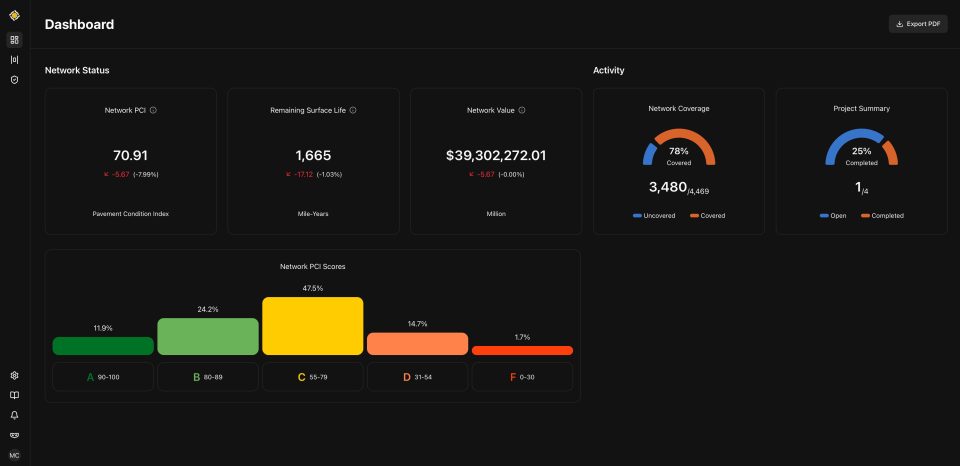
Experience and data working together, giving engineers the network-level visibility needed to make confident, defensible decisions.
Experience Informs. Data Clarifies.
Our roadway lifecycle management platform can identify a declining PCI score and forecast deterioration curves. It can model the financial impact of deferring treatment by two years. It can compare the ROI of a slurry seal versus a mill and overlay.
What it cannot do is understand the full local context. It doesn’t know that a corridor supports seasonal agricultural traffic. It doesn’t anticipate upcoming utility cuts. It doesn’t account for subgrade variability that’s caused recurring failures.
That interpretation belongs to professionals.
When objective condition data is layered onto real-world expertise, decisions become clearer, faster, and more defensible.
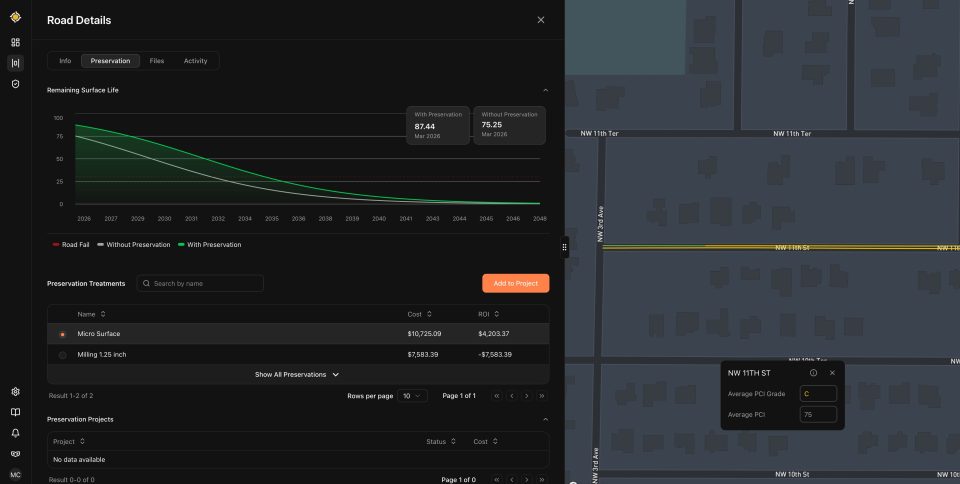
Visualizing long-term performance and financial impact so preservation strategies can be prioritized with confidence.
From Instinct to Evidence
For decades, many infrastructure decisions relied heavily on professional instinct. That instinct remains incredibly valuable. But today’s funding environment requires more than internal confidence, it requires external justification.
Data transforms instinct into evidence.
Instead of saying, “This road feels like it needs treatment,” agencies can say, “This segment has dropped below our performance threshold, and applying preservation now yields the highest lifecycle ROI.”
That shift changes conversations.
It strengthens budget requests.
It improves transparency with elected officials.
It builds trust with the public.
The decision still belongs to the professional. The data simply reinforces it.
Empowerment, Not Automation
There’s a misconception that analytics platforms are designed to automate infrastructure decisions. In reality, the goal is empowerment. Data reduces uncertainty. It surfaces patterns that are difficult to detect at scale. It quantifies trade-offs that would otherwise remain abstract. But it does not remove leadership from the process.
Professional judgment still determines priorities, balances competing constraints, and ultimately signs off on the plan. Technology simply strengthens the foundation on which those decisions are made. As roadway networks grow more complex, the agencies that succeed will be those that combine technology with expertise, not one at the expense of the other.
Data is a tool.
Judgment is the driver.
Together, they create smarter preservation strategies, longer pavement lifecycles, and stronger stewardship of taxpayer dollars.
Ready to see how data can strengthen your decision-making process?
Connect with our team to explore how real-time roadway intelligence can support your network, your priorities, and your professional judgment.