

Most agencies collect PCI data every three to five years. However, all too often it remains a report instead of a roadmap and the data is already out of date when it is supplied. A PCI score only becomes valuable when it directly informs treatment decisions, budget allocation, and long-term planning. The real opportunity lies in understanding what each condition range demands and acting before deterioration accelerates. Turning data into strategy is what protects both pavement performance and public dollars.
PCI 85–100: Preserve the Asset While It’s Strong
Roads in excellent condition are structurally sound but could be beginning to show early surface aging such as oxidation or minor cracking. This is the most cost-effective window for preservation treatments that slow deterioration and extend functional life. When agencies intervene early, they prevent rapid decline and significantly reduce long-term rehabilitation costs. Missing this window often means paying exponentially more just a few years later. This is no different than changing the oil in your car every 5,000 miles, or staining your fence to protect against the elements; proactive vs reactive at the earliest stages of a road’s lifecycle.
PCI 70–84: Protect the Tipping Point
Pavements in this range still qualify for preservation, but the margin for error narrows. Moderate cracking and early fine loss signal that decline is accelerating, even if the road still looks “good” to the public. Strategic surface treatments or thin overlays at this stage prevent structural issues from developing. Acting here keeps roads out of the expensive middle ground where repair costs rise quickly.
PCI 50–69: Substantial Deterioration Begins to Surface
At this stage, deterioration becomes more visible, to include structural concerns, and more expensive to address. Ride quality declines, cracking expands, and localized failures begin to impact performance. Preservation options become limited, and structural interventions such as mill and overlay are often necessary. Deferred action in earlier years typically reveals itself here in the form of budget strain and growing backlog.
PCI Below 50: Reactive Spending Takes Over
When pavements fall below 50, agencies are no longer preserving assets but rebuilding them. Major rehabilitation or reconstruction becomes the primary option, carrying significantly higher costs per mile. Networks with a high percentage of roads in this range often indicate years of deferred preservation upstream. By the time roads reach this stage, flexibility in budgeting and planning has largely disappeared.
Turning Strategy into Projects with RMT
Understanding PCI ranges is only the first step; the real challenge is building optimized preservation plans from that data. RMT’s project management system provides users with project creation tools that utilizePCI data to build defensible, budget-aligned projects by identifying the right treatment options, forecasting ROI, and modeling network impact before funds are invested.
Agencies can pick and choose which preservation treatments they want in their account based on the options available in their geographical area and their own experience. RMT does not dictate treatments but instead applies industry standards to model their effects on pavements. Instead of reacting to deterioration, agencies can proactively bundle projects and align preservation strategies with long-term performance goals, allowing maintenance decisions to become measurable, defensible, and financially sustainable.
Let’s take a look at specific examples and see how RMT’s application helps decision makers plan for the future.
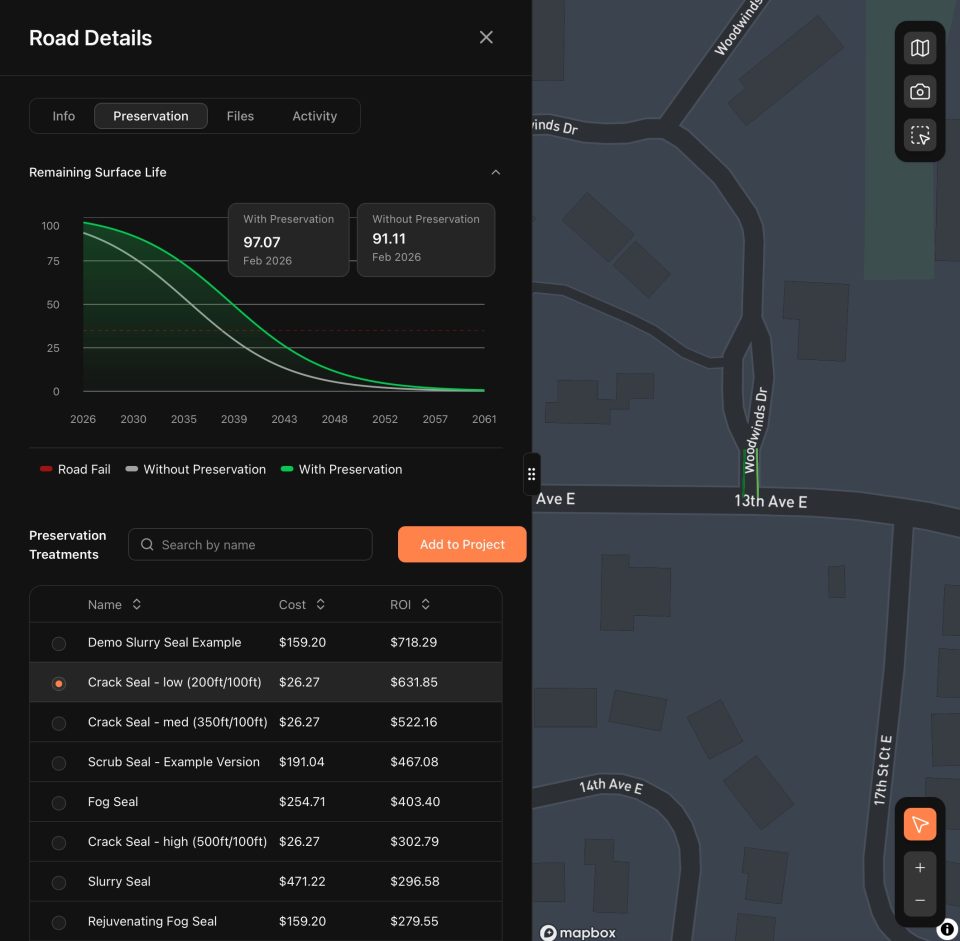 Let’s say we have an “A”-rated road. It’s still early in its life, but very slight deterioration may just be beginning to appear.
Using the current PCI rating, the RMT application’s Project Planning tool references the user-defined decision matrix to suggest preservation treatments that may be appropriate.
For this road with a PCI of 91, several options are applicable. A crack seal, especially this early in the road’s surface life, is a low-cost effort that can help protect the road from further deterioration.
 In this example, we’re looking at a road with a PCI of 80, which falls into the “B” category. The pavement is still in good condition, but deterioration is beginning to affect overall quality.
Using RMT’s project planner, we can identify that this segment would be a strong candidate for treatments such as a slurry seal or a fog seal.
The tool also shows the projected ROI for each option, allowing decision makers to ensure every dollar is spent wisely.
.
Build Smarter, Data-Driven Maintenance Plans
If your PCI data isn’t actively shaping your maintenance strategy, it’s time to rethink how it’s being used. See how RMT transforms pavement condition data into prioritized, budget-aligned projects that extend network life and reduce long-term costs.
Schedule a demo to see RMT’s project creation tools in action.